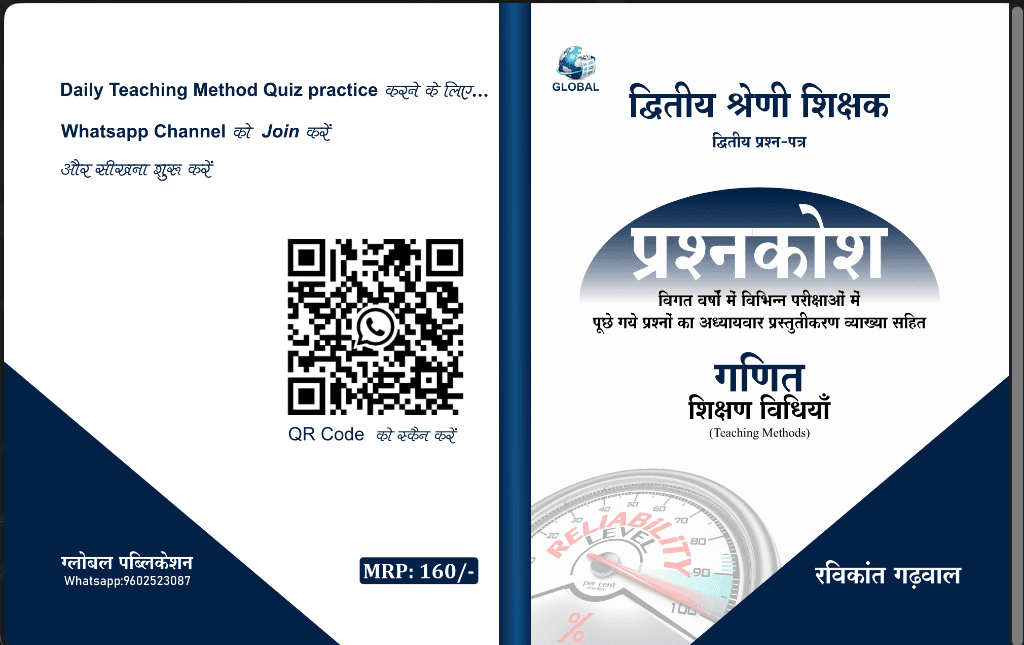
Best Mathematics Teaching Methods for RPSC 2nd Grade
Table of Contents
The Challenge of Teaching Methods
In the RPSC 2nd Grade Teacher exam (Paper II), Teaching Methods (Shikshan Vidhiyan) constitute a highly scoring but often neglected section. For Mathematics aspirants, understanding pedagogical concepts is just as important as solving complex calculus equations. While many candidates score well in core math, they lose crucial marks in pedagogy due to a lack of understanding.
1. Inductive-Deductive Method (आगमन-निगमन विधि)
This is the absolute backbone of math teaching. The Inductive method involves moving from specific examples to general formulas (Example to Rule). It is heavily used in primary classes to establish concepts.
The Deductive method does the opposite: it applies general formulas to specific problems (Rule to Example). RPSC frequently asks situational questions based on this. For instance, "If a teacher gives the formula of a cylinder's volume and asks students to find the volume, which method is being used?" (Answer: Deductive).
2. Analytic-Synthetic Method (विश्लेषण-संश्लेषण विधि)
The Analytic method involves breaking down a complex problem into simpler, solvable parts. It is essentially asking "What do I need to find, and how do I get there?" It is especially relevant in geometry proofs.
The Synthetic method is the reverse: combining known facts to discover the unknown. Teachers usually use Analysis to explain the proof, but students write the proof in the exam using Synthesis.
3. Heuristic Method (ह्यूरिस्टिक विधि)
Discovered by H.E. Armstrong, this method places the student in the position of an active discoverer rather than a passive listener. The word "Heuristic" comes from the Greek word "Heurisko," meaning "I find." You must know the merits (promotes independent thinking) and demerits (time-consuming, not suitable for primary kids) of this approach for the exam.
4. Project Method (प्रायोजना विधि)
Pioneered by W.H. Kilpatrick, this method involves teaching mathematics through real-life, purposeful activities carried out in a social environment (like organizing a mock bank in the classroom to teach compound interest).
How to Study the "Ganit Shikshan" Book
If you have purchased a standard 'Ganit Shikshan Vidhiyan' book (such as the Ganit Shikshan Vidhiyan by R.K. Vaishnav available in our store):
- Don't just memorize definitions; understand the practical classroom application of each method.
- Pay special attention to the chapter on "Evaluation in Mathematics" (मूल्यांकन). Questions on Continuous and Comprehensive Evaluation (CCE) and the differences between Formative and Summative assessments are guaranteed.
- Solve all the MCQ practice sets provided at the end of every chapter.
Key Topics to Memorize
- ✓ Definitions of Mathematics given by famous philosophers (Locke, Bacon, Gauss)
- ✓ Steps involved in the Project Method
- ✓ Characteristics of a good mathematics textbook
- ✓ Taxonomies of Educational Objectives (Bloom's Taxonomy)
- ✓ Remedial and Diagnostic Teaching differences
Frequently Asked Questions
It generally carries 40 marks (20 questions) out of the total 300 marks in Paper II.
Dwight W. Allen developed the concept of Micro-Teaching.
Extremely important. You must know the Cognitive, Affective, and Psychomotor domains thoroughly.
It is a test designed specifically to identify the exact areas of learning difficulties or misconceptions a student has in math.
No! The pedagogy section is highly scoring and takes less time to solve in the exam hall compared to lengthy calculus problems.
The core concepts are identical, but the depth and application scenarios asked in 2nd Grade are much tougher.
Study in the language you are most comfortable with, but since RPSC papers are bilingual, knowing the exact Hindi terminology (e.g., आगमन विधि) is crucial.
You can purchase highly-rated pedagogy books directly from our Educational Books Store with fast shipping across Rajasthan.
Conclusion
Do not underestimate the power of Ganit Shikshan Vidhiyan. By mastering these teaching methods, you are practically securing 40 free marks that require zero complex calculations in the exam hall. Study smart, understand the application of these methods in a real classroom, and practice extensively.
Written by Global Emitra Shop Editorial Team
Our editorial team researches and publishes educational resources, government service guides, and digital service information for students and citizens across Rajasthan.